
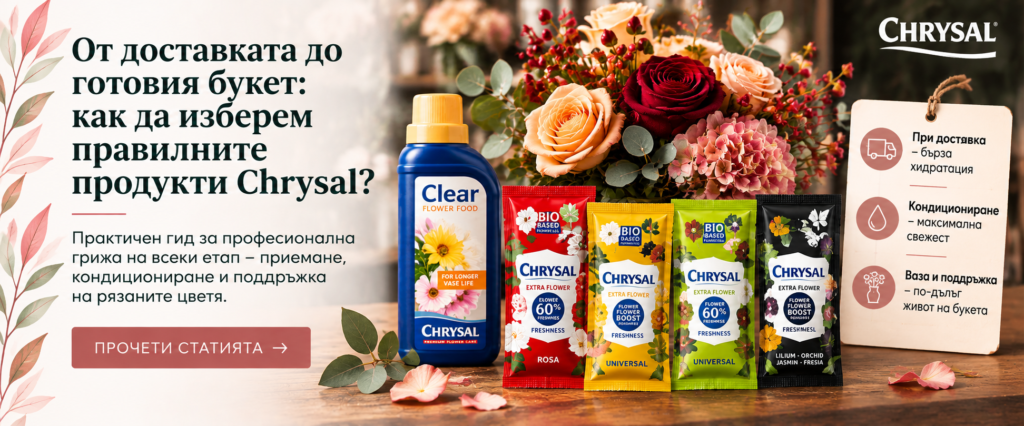
In professional floristry, a beautiful bouquet is the result of much more than a good sense of colour and composition.
Before the roses are arranged, before the alstroemeria finds its place and before the finished bouquet is wrapped, the flowers go through several important stages.
They are delivered, received, processed, stored and only then reach the florist’s workbench.
Each of these stages has its own requirements.
That is why professional flower care cannot be reduced to a single universal product used in the same way in every situation.
Why is it important to distinguish the different stages?
Imagine a flower shop receiving a new delivery of roses and alstroemeria.
Some of the flowers will be used the same day. Others will stay in the shop until they are included in later orders.
Some will become part of large arrangements, while others will be sold as individual bouquets.
Although all of them are cut flowers, they are not at the same stage of their commercial life.
That is why the approach to care must be different.
Stage 1: Receiving the delivery
The first task after receiving the flowers is a careful inspection.
The florist should pay attention to the condition of the stems, leaves and blooms.
It is also important to check for mechanical damage, unusual wilting or other signs that certain flowers need special attention.
Then the preparation for placing them in water begins.
Depending on the type of flowers and the technology used, it may be necessary to refresh the cut of the stems.
All containers must be cleaned beforehand.
Even at this stage, good organisation can prevent problems later.
Stage 2: Conditioning the flowers
Conditioning is an important part of professional handling.
The goal is to prepare the flowers for storage and subsequent use under suitable conditions.
Among Chrysal’s solutions for this stage is Chrysal Professional 2.
The product range also includes Chrysal FlowPro 2, designed for professional conditioning under specific conditions of use.
Different products have their own characteristics and instructions, so they should not be considered fully interchangeable.
The right choice depends on the workflow, the type of flowers and the manufacturer’s recommendations.
Stage 3: Storage and display in the shop
After the initial treatment comes the next challenge – the flowers must keep their decorative appearance until they are sold.
This is especially important for shops that maintain a wide assortment.
Roses, spray roses and alstroemeria can be used in many compositions, but they are not always sold on the day of delivery.
That is why storage conditions matter greatly.
The temperature must be suitable for the flowers concerned, containers must be clean, and the water solution must be prepared according to the instructions of the product used.
For professional care under the relevant display conditions, Chrysal Professional 3 can be used.
It is part of the solutions aimed at maintaining the quality of cut flowers.
Stage 4: Hygiene of the workspace
Cleanliness is an integral part of professional care.
In a flower shop, buckets, vases, tools, worktops and various containers are used every day.
If organic residue and dirt build up on them, storage conditions can deteriorate.
That is why cleaning should be a regular practice, not something done only when a problem is noticed.
Chrysal also offers specialised hygiene products that can be included in the organisation of the workspace.
It is important to follow the instructions for use, including requirements for concentration and rinsing where applicable.
Stage 5: Making the bouquet
When the flowers reach the workbench, the most visible part of the process begins.
The florist selects the blooms, builds the composition and shapes the final product.
But proper care matters here too.
If the stems have been prepared incorrectly or the flowers have been stored in unsuitable conditions, even a beautiful arrangement may not live up to expectations.
That is why the quality of a bouquet begins long before the arranging itself.
When working with large quantities of flowers, it is especially helpful to have an established process that all team members follow.
Stage 6: Preparing for handover to the customer
Once the bouquet is ready, one more important step remains.
The customer should receive information on how to care for the flowers at home.
For professional florists this is an opportunity to show extra attention.
A small sachet of suitable flower food, accompanied by brief instructions, can be a valuable part of the overall service.
This is especially suitable for gift bouquets, when the recipient was not present in the shop and has no opportunity to ask questions directly.
What should the end customer know?
Complicated explanations are not needed.
A few clear tips are enough:
- Use a clean vase and a suitable amount of water.
- Add the flower food according to the instructions on the packaging.
- Place the bouquet away from direct sources of heat.
- Avoid direct sunlight and strong air currents.
- Keep an eye on the condition of the water and stems.
This kind of information helps the customer care for their bouquet with more confidence.
It also underlines the shop’s professional approach.
Why is one product not enough for everything?
This is one of the most important questions when choosing care products.
Different formulas are developed with different purposes.
A product for initial conditioning should not automatically be used as a substitute for food for finished bouquets.
Likewise, a cleaning agent does not perform the functions of a storage solution.
When a florist understands the purpose of each category, they can build a more effective system of work.
This is especially important for professional shops that process large quantities of cut flowers every day.
How can we build a better workflow?
The first step is to divide the activities into clear stages.
Define how deliveries are received, how stems are prepared, which containers are used and how the necessary solutions are prepared.
Then review the products you work with.
Do you have a suitable conditioning solution? Are you using the right product when displaying the flowers? Do you have specialised hygiene products? Do you offer flower food to end customers?
The answers to these questions can show where there is room for improvement.
Why is November a good time for change?
November is the month in which many flower shops begin preparing for the busier end of the year.
It is a good time to review not only flower deliveries, but also stocks of professional consumables.
When the workflow is organised in advance, the team can focus on serving customers and making arrangements.
Better preparation reduces the need for improvisation on the busiest days.
Where can you find the right solutions?
At FlowerFood.bg you can browse a specialised range of Chrysal products for the different stages of professional flower care.
The online store includes solutions for conditioning, keeping flowers fresh, hygiene and care of finished bouquets.
This way florists can choose products according to the real needs of their business.
Conclusion
Professional flower care is a consistent process in which every step matters.
From the initial conditioning to the handover of the finished bouquet, the right conditions and suitable products help preserve quality.
Chrysal solutions allow florists to approach the different stages of their work in a more organised way.
And with the new online store FlowerFood.bg, specialised flower care products are gathered in one place.
Because a professional bouquet does not start with the wrapping. It starts with the right care.


